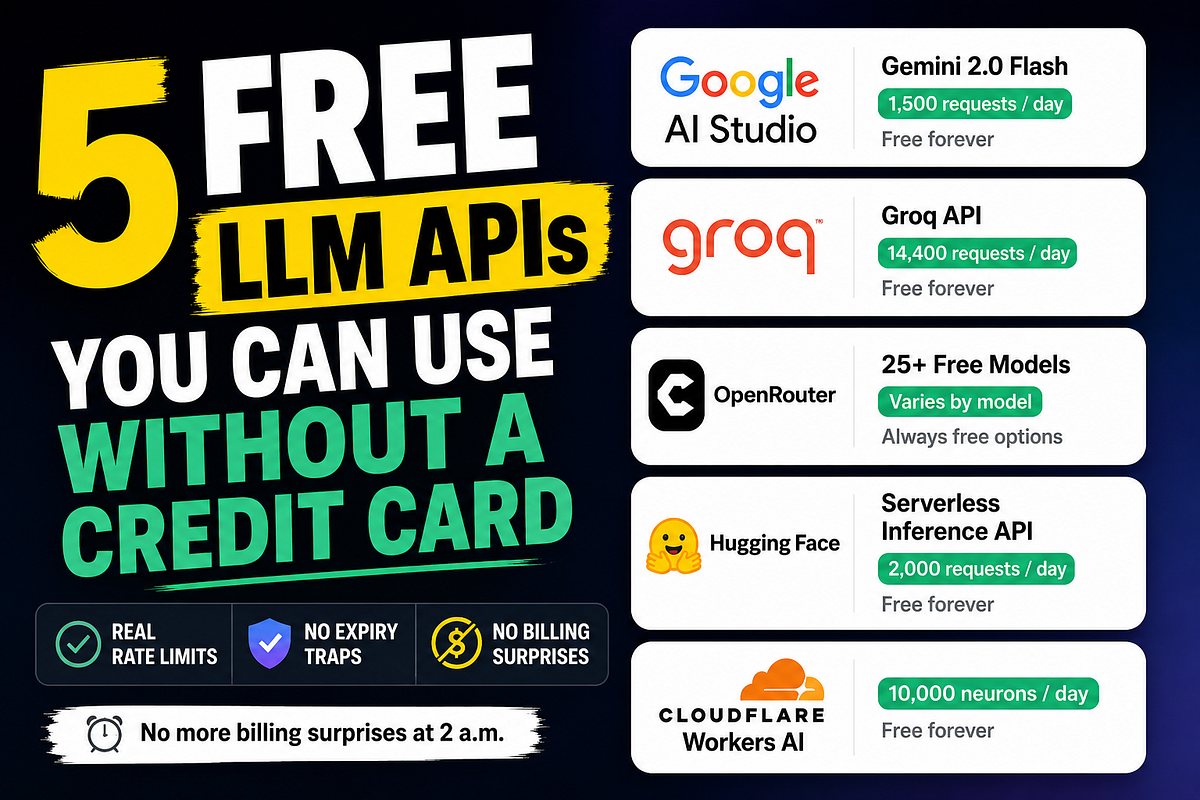
The $32 Wake-Up Call: Why Developers Are Fleeing Credit-Card-Gated AI Access
The era of hidden costs and late-night billing shocks in the AI development space is officially over, thanks to developer fatigue. A recent incident involving a side project hitting an unexpected trial expiration resulted in a painful $32 charge, acting as a catalyst for a massive community shift. Developers are demanding transparency, permanence, and—most critically—zero credit card friction for initial experimentation and scaling. This demand isn’t just about saving money; it’s about maintaining momentum when iterating on proof-of-concepts, where a 401 error due to an expired trial can derail days of work.
Sifting through over 50 inadequate offerings, the consensus is clear: most “free tiers” are traps designed to harvest payment information or impose crippling expiration clauses. The market response has surfaced a handful of surprisingly generous, truly sustainable free alternatives. These providers understand that access fuels adoption, and locking away powerful models behind a financial gate stifles the very innovation they seek to benefit from.
The Undisclosed Google Powerhouse: 1,500 Daily Frontier Requests
The single most stunning revelation is that major players are quietly offering significant, long-term free access that developers are largely unaware of. Forget the small-scale, token-limited playgrounds; one specific Google offering provides an astonishing 1,500 requests per day utilizing a frontier model. This is not a trial; the input data emphasizes “No card. No expiry. No catch.” This level of resource commitment, especially for a high-performance model capable of complex reasoning, fundamentally alters the cost curve for early-stage AI startups and hobbyists.
For context, achieving this volume of calls through token-based billing on comparable commercial models, even at competitive rates like $0.28/M tokens for lesser models, would still incur overhead. The implication here is a strategic play by Google to capture mindshare and dataset generation early on, knowing that once an application architecture is built around their free endpoint, migration costs become substantial. Developers must immediately reassess their testing infrastructure to leverage this massive, risk-free capacity.
The Criteria for True, Sustainable Free LLM Access
Suraj Jha’s personal vetting process established three non-negotiable benchmarks for an API to be considered genuinely useful in 2026: real, enforceable rate limits (not just soft caps), zero hard expiry dates, and absolutely no unexpected billing mechanisms. Many services fail because their free tier is tied to a subscription that auto-renews, or the underlying model architecture is deliberately throttled to unusable speeds after a short period.
The five APIs that passed this rigorous test represent a distinct class of service providers. They are playing the long game, focusing on developer onboarding rather than immediate monetization. This shift indicates a maturation in the LLM ecosystem, where infrastructure provision is beginning to treat developer access as a utility rather than a high-touch sales item. This reliability is key for building production-ready code.
Architectural Implications: Building Without Credit Card Anxiety
The existence of these five reliable, no-CC-required APIs has profound consequences for software architecture. Previously, developers had to build complex fallback mechanisms, API key vaulting for payment gateways, and user consent workflows just to deploy a basic prototype. Now, engineers can focus purely on prompt engineering, model fine-tuning, and application logic, knowing their foundational inference layer is stable and free.
This dramatically lowers the barrier to entry for new entrants into the AI sector. Imagine a university project or a small non-profit building complex NLP pipelines without ever needing to secure a corporate purchasing card or expose personal financial data. The quoted resources suggest that even advanced tasks previously reserved for paid enterprise tiers are now accessible, enabling innovation that was financially infeasible just a year prior.
Note: The information in this article might not be accurate because it was generated with AI for technical news aggregation purposes.
Leave a Reply