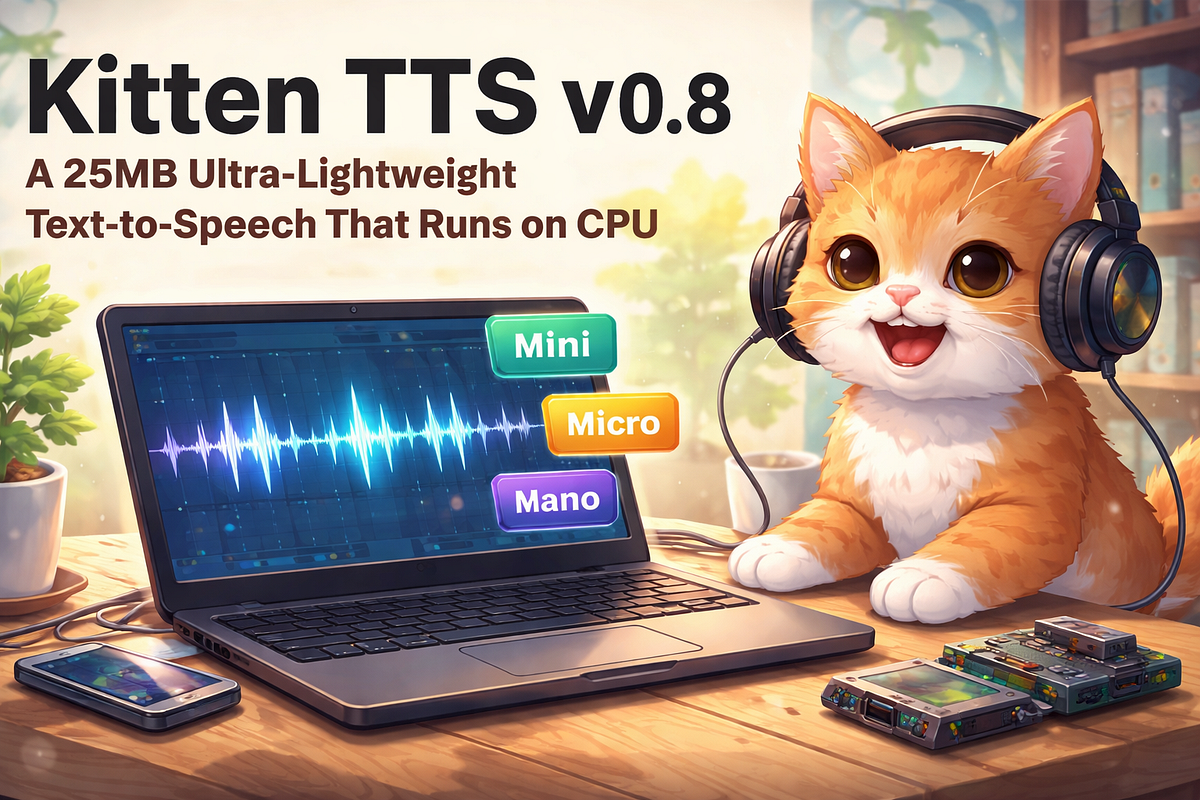
The End of Cloud-Bound Voice Synthesis: Introducing Kitten TTS
The landscape of AI deployment is undergoing a seismic shift, moving processing power from centralized behemoths to localized, edge devices. The introduction of Kitten TTS, an ultra-lightweight Text-to-Speech (TTS) solution, epitomizes this trend. Where state-of-the-art voice models often demand massive computational resources, requiring constant cloud connectivity and incurring significant API costs, Kitten TTS boasts a startlingly small footprint—a mere 25MB across its Mini, Micro, and Nano configurations. This breakthrough immediately changes the calculus for developers targeting constrained environments like IoT sensors, budget mobile applications, and, most compellingly, embedded systems such as the Raspberry Pi.
This shift is critical for ensuring data privacy and reducing latency. When TTS processing happens locally on the CPU, user audio data never needs to leave the device, satisfying stringent compliance requirements. Furthermore, the elimination of network round-trips means near-instantaneous voice output, a necessity for real-time user interaction in smart devices. The design philosophy explicitly targets scenarios where internet access is intermittent or non-existent, presenting a viable, high-quality alternative to traditional, latency-plagued cloud solutions.
CPU-First Architecture: Redefining Edge AI Viability
The most radical aspect of Kitten TTS is its proficiency in running entirely on a standard CPU, bypassing the traditional reliance on powerful GPUs that define most modern deep learning infrastructure. This is not merely a proof-of-concept; it’s production-ready technology engineered for breadth of deployment. While the input data doesn’t explicitly detail parameter counts for the various Kitten models (Mini, Micro, Nano), the 25MB model size strongly implies highly optimized quantization and architecture pruning, likely placing their effective parameter count far below those of massive models topping hundreds of billions of parameters, such as recent 744B or 397B LLMs discussed in other contexts.
For the developer community, this translates into unprecedented accessibility. Previously, integrating high-fidelity voice into a low-power device meant either accepting severely degraded quality or implementing a complex, power-hungry hybrid system. Kitten TTS promises expressive voice generation without the thermal and power constraints associated with GPU acceleration. This opens the door for voice assistants and narration features to become standard across all tiers of consumer electronics, not just premium flagship devices.
The Economic Argument: Bypassing Token Costs
Cloud-based services are notorious for their usage-based pricing models, often quoted in costs per million tokens (e.g., benchmarks comparing models at $0.28/M tokens for comparison purposes). For applications requiring frequent or high-volume speech generation, these costs accumulate rapidly, creating significant operational expenditure (OpEx). Kitten TTS, being an open-source, locally executable model (as suggested by the GitHub repository mention), effectively zeroes out this recurring usage fee.
The economic implication is profound for startups and large-scale IoT deployments. A company deploying thousands of proprietary smart devices can now integrate advanced voice capabilities without factoring in a variable runtime cost per interaction. The investment shifts entirely to upfront hardware and integration engineering, leading to predictable, lower total cost of ownership over the device lifecycle. This economic decoupling from major cloud providers is a massive advantage for sustainable scaling.
Implications for Competitive TTS Ecosystems
The release of Kitten TTS will undoubtedly pressure established TTS vendors and cloud providers. Existing commercial offerings often justify their pricing based on superior voice quality, but if a 25MB CPU model can deliver “high-quality, expressive” output—as implied by the article snippet—the value proposition of expensive, cloud-only APIs diminishes significantly for edge use cases. Developers will now weigh the marginal quality improvements of a large cloud model against the guaranteed privacy, zero latency, and zero operational cost of the local Kitten solution.
Furthermore, the open-source nature, evidenced by the prominent GitHub link, fosters rapid community development and iteration. This contrasts sharply with proprietary black-box solutions. We can anticipate custom fine-tuning, language pack additions, and specialized optimizations for niche CPUs emerging quickly from the community, a natural consequence of accessible, lightweight core technology. This democratizing effect challenges models optimized strictly for GPU parallelism, proving that efficiency and size can indeed triumph in specific deployment spheres.
Note: The information in this article might not be accurate because it was generated with AI for technical news aggregation purposes.
Leave a Reply