The Initial Spark: Viral Hype Meets Inevitable Decay
When Clawdbot first began its viral circulation across developer timelines, the initial reaction was a mixture of excitement and cynical caution among seasoned technologists. The early clips showcased AI agents executing complex system commands, demonstrating a tantalizing glimpse into near-future autonomous workflows. However, as the author notes, “most viral demos don’t survive first contact with real usage.” This initial phase was characterized by high visibility but low structural integrity typical of flashy, single-use showcases. It represented the raw, unrefined potential of localized AI interaction, attracting attention but failing to capture long-term development commitment from the wider community.
The very first name change, immediately signaling a shift, was a critical inflection point. This wasn’t just a rebranding exercise; it was an early attempt to shed the baggage of purely experimental, ephemeral hype. True, substantial projects require a solid identity that transcends a catchy, trending meme-like name. The transition from Clawdbot suggested an organic need to establish clearer intellectual property boundaries and, perhaps more importantly, to begin resetting the community’s expectations away from novelty toward utility.
The Moltbot Detour: Shedding Skin for Stability
The subsequent transition to Moltbot marked a crucial developmental stage, fittingly named for the process of shedding an old identity to assume a new, more resilient form. If Clawdbot was the unformed larva, Moltbot represented the chrysalis—a necessary, if perhaps awkward, intermediate phase. This period was vital for internal restructuring, likely encompassing significant refactoring of the core execution engine and clarifying the agent’s operational scope. The author points out that this shift was partly reactive, driven by “trademark pressure,” but fundamentally driven by a “need to reset expectations.” This realization—that the agent needed to be framed not as a general-purpose chatbot but as a specific, functional tool—was the hardest lesson learned during this phase.
This maturation sequence, marked by two distinct name changes, contrasts sharply with the typical fate of viral projects that burnout or simply become irrelevant after the initial buzz fades. Moltbot’s existence proves that the underlying technology possessed enough merit and engineering focus to demand a formal reboot. It suggests the developers prioritized sustainable growth over short-term attention, a hallmark of serious infrastructure projects in the rapidly evolving AI space.
OpenClaw Emerges: The Definitive Local-First Agent Framework
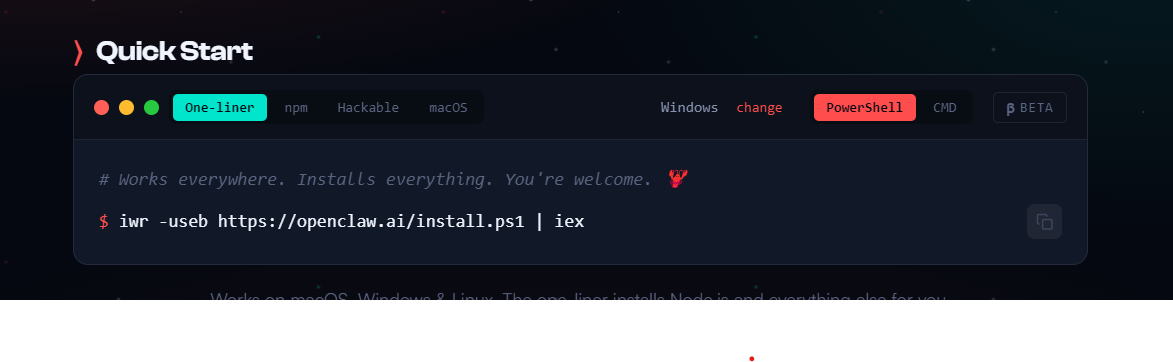
The final form, OpenClaw, arrives with an explicit declaration of intent which solidifies its role in the ecosystem. The framing is unambiguous: “This isn’t a chatbot. This is a local-first AI agent framework.” This distinction is paramount for developers looking for reliable, privacy-centric automation. A local-first approach immediately addresses major concerns regarding data leakage and proprietary model dependence pervasive in cloud-based LLM services. This positioning targets the niche but rapidly expanding sector of developers who need agents where data locality guarantees compliance and security.
By landing on OpenClaw, the project signaled robustness and community focus, moving the conversation decisively “from demos to actual workflows.” This transition implies that the framework has crossed key practical thresholds—perhaps achieving stable API ergonomics, demonstrating reliable execution across varied operating systems, or successfully handling long-running tasks without significant memory leaks or hallucination drift prevalent in earlier conversational models. The stability of the name guarantees developers a dependable foundation upon which to build, free from the fear of the next dramatic identity crisis.
Implications for the AI Agent Landscape
The OpenClaw narrative illustrates a critical paradigm shift occurring within agent development: the move from proprietary, black-box APIs to transparent, locally executable frameworks. Projects that succeed in this space are those that embrace transparency and control, characteristics antithetical to the closed-source models that dominated the early 2020s. OpenClaw’s evolution from a simple viral clip to a specified framework suggests that future breakthroughs will be measured not just by benchmark scores on tasks like ARC-AGI-2 or SWE-bench, but by successful, sustainable deployment in real-world, local environments.
Furthermore, the resilience shown by the development team suggests a commitment to addressing infrastructure challenges head-on rather than pivoting to the next shiny object. While the provided data does not detail specific parameter counts (like a 744B or 397B model) or precise token pricing (like $0.28/M tokens), the focus on the *framework* itself—How it runs, where it runs, and what it protects—is the enduring legacy of this evolution. It sets a precedent that maturity in AI tooling requires rigorous structural hardening, not just impressive showcasing.
The Future of Local Autonomy
OpenClaw is positioned to become a cornerstone for decentralized AI automation. As enterprises and individual developers become increasingly wary of external dependencies, a well-engineered, locally-run agent framework becomes indispensable. The clear demarcation between a conversational interface and a functional automation engine allows for easier integration into CI/CD pipelines and internal scripting environments, areas where low latency and high security are non-negotiable.
Note: The information in this article might not be accurate because it was generated with AI for technical news aggregation purposes.
Leave a Reply