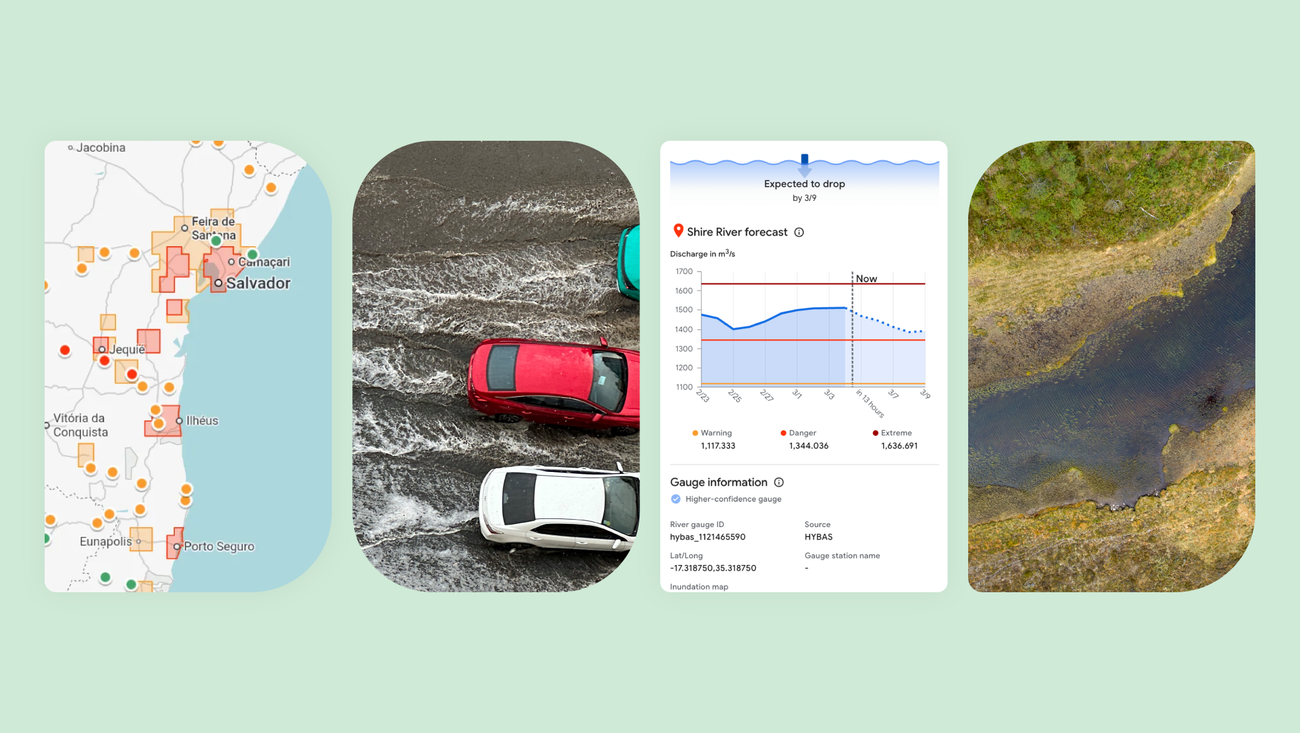
The Groundsource Revolution: From Data Noise to Disaster Signal
Google Research is fundamentally shifting the paradigm of disaster preparedness with the unveiling of Groundsource, a new AI-powered methodology designed to synthesize massive volumes of unstructured public records into verifiable, actionable intelligence. This isn’t just incremental machine learning; it’s a specialized framework aimed directly at boosting community resilience against natural hazards like flooding, as exemplified by the FloodHub initiative. The core innovation lies in transforming bureaucratic data sludge—permitting documents, historical reports, anonymized sensor data—into real-time predictive variables that current hydrological models often miss due to their reliance on structured datasets.
This approach demands sophisticated data ingestion and validation pipelines, likely employing advanced natural language understanding (NLU) models layered atop the foundational Gemini architecture. By extracting latent knowledge from documents that previously required manual, labor-intensive review, Groundsource dramatically reduces the latency between data availability and decision-making. The implications extend far beyond flood mapping; imagine applying this methodology to infrastructure failure prediction or epidemiological risk assessment using regulatory filings and maintenance logs.
Demystifying Gemini: The Engine Behind the Intelligence Surge
While Groundsource addresses domain-specific challenges, it is intrinsically powered by the broader advancements in Google’s core AI models. The recent milestones achieved by Gemini models—spanning parameter counts that reportedly reach colossal figures, potentially rivaling or exceeding the 744B figures discussed in previous research developments—demonstrate the raw compute power now available to tackle these complex, multi-modal tasks. The shift towards multimodal reasoning, allowing models to natively process text, images (like those powering FloodHub’s visualization), and geospatial data simultaneously, is the hidden prerequisite for Groundsource’s success.
Furthermore, the integration across Google’s infrastructure—from Google Cloud providing the scalable backbone to the specialized research insights from Google DeepMind—showcases a unified commitment to deploying cutting-edge research rapidly. Developers looking to engage with these powerful capabilities will find standardized access through the Google Developers blog, signaling clear pathways for external adoption, although the proprietary nature of the Groundsource methodology itself remains focused on high-consequence public sector applications initially.
The Infrastructure Play: Cloud Scalability Meets Real-Time AI
The performance required to process “millions of public records” for disaster prediction necessitates an unassailable cloud architecture. Google Cloud’s role here cannot be overstated; running complex simulations and inference engines based on Groundsource requires elastic scaling that can handle massive ingestion peaks when a disaster looms. This environment is crucial for maintaining the low-latency response times critical for early warning systems. Anecdotally, improvements in cloud infrastructure efficiency are what make previously unfeasible task pipelines—like cross-referencing 10 years of municipal drainage reports with real-time river level data—become viable production systems.
The economic implications for deploying such computationally intensive services are also noteworthy. While specific pricing for Groundsource isn’t public, industry trends—such as competitive token pricing dropping towards $0.28/M tokens for foundational models—suggest that the cost barriers for large-scale data processing are rapidly eroding. This democratization of high-compute AI capabilities is what allows specialized tools like Groundsource to move from purely academic exercises into tangible, deployed solutions impacting municipal operations.
Beyond DeepMind: The Cross-Pollination of AI Initiatives
The sheer breadth of recent AI updates—spanning Google Labs experimentation, dedicated focus areas in Safety & Security, and outreach via Google.org—indicates a strategy of broad but targeted innovation. Groundsource appears to be a direct beneficiary of foundational research breakthroughs originating in DeepMind and Google Research, but its successful deployment rests on its integration with public-facing products utilized by emergency services, potentially leveraging platforms like Google Maps for visualization and dissemination.
This ecosystem approach means that advancements in one area—say, faster inference for Gemini models—immediately benefit another, like the complex pattern recognition within Groundsource. For developers, this means the tooling ecosystem, including Developer tools updates seen across the ecosystem, is becoming increasingly rich, providing standardized APIs to leverage these high-level capabilities, even if the underlying Groundsource mechanism remains proprietary for now.
The Developer Roadmap: Preparing for the Next Wave of Applied AI
For the development community monitoring dev.ejohnny.ro, the message is clear: the future of applied software engineering involves managing and operationalizing systems built on massive, unstructured data ingestion. While specific benchmark scores like ARC-AGI-2 or SWE-bench performance metrics are often internal indicators for core model capabilities, the practical outcome for developers is simpler integration with increasingly capable foundation models. The focus shifts from building basic NLP pipelines to architecting resilient, ethically sound ingestion layers capable of feeding systems like Groundsource.
The industry must prepare for a sharp pivot toward specialized AI methodologies. Understanding how frameworks abstract unstructured data into structured insights—the core of Groundsource—will be more valuable than ever. Expect a surge in demand for engineers who can bridge the gap between cutting-edge Google Research papers and robust, mission-critical applications safeguarding communities from events like the ones depicted in FloodHub imagery.
Note: The information in this article might not be accurate because it was generated with AI for technical news aggregation purposes.
Leave a Reply